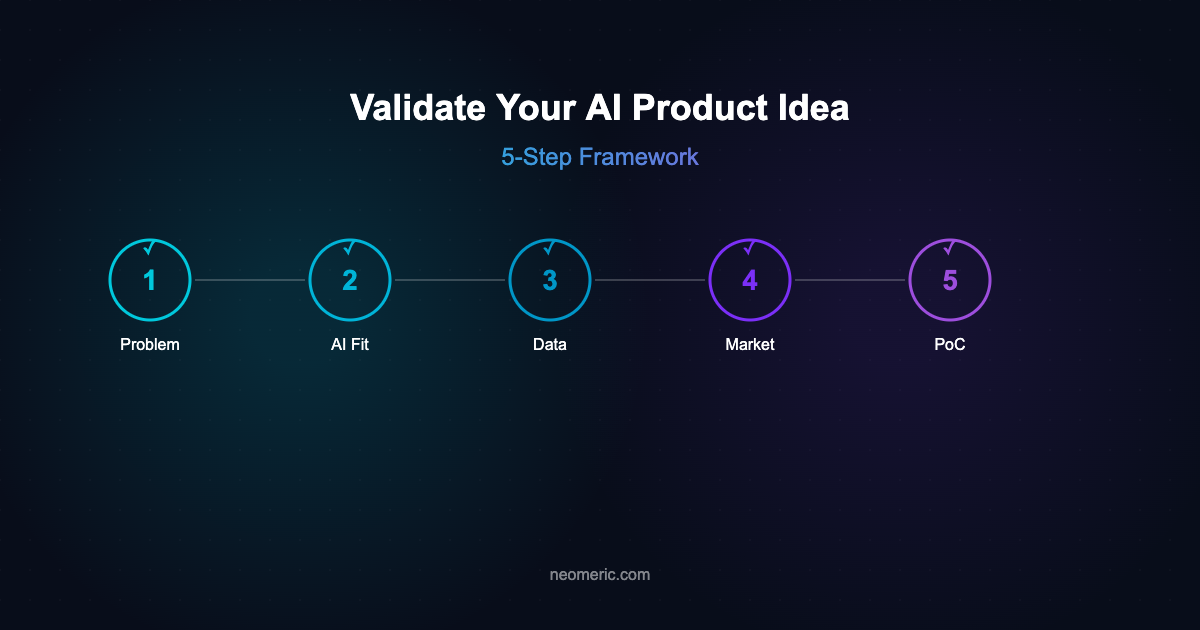
How to Validate an AI Product Idea in 5 Steps
Not every AI product idea deserves to be built. Before you invest months of development time and tens of thousands of dollars, you need a structured way to separate promising concepts from expensive distractions. Here’s a practical, five-step framework for validating an AI product idea — so you can move forward with confidence or kill it early.
Why AI Products Need a Different Validation Approach
Traditional software validation focuses on user demand and technical feasibility. AI products add extra layers of complexity: you need the right data, the right model architecture, and a clear reason why AI outperforms simpler alternatives.
Skipping validation is one of the most expensive AI mistakes businesses make. The good news? A structured checklist can save you from building something nobody needs — or something that’s technically impossible.
Step 1: Confirm the Problem Is Real and Painful
Before you think about models or data, answer one question: does this problem actually cause measurable pain for a specific group of people?
What to do:
- Talk to at least 10 potential users. Ask about their current workflow, frustrations, and what they’ve already tried.
- Quantify the cost of the problem. If nobody can put a dollar figure (or time figure) on the pain, it’s probably not painful enough.
- Check whether people are already paying for imperfect solutions — spreadsheets, manual processes, or competing tools.
Red flag: If your interviews keep producing polite interest but no urgency, the problem isn’t validated.
Step 2: Verify That AI Is the Right Solution
AI is powerful, but it’s not always the best tool. A rules-based system, a simple automation, or even a better spreadsheet might solve the problem faster and cheaper.
Ask yourself:
- Does the task involve pattern recognition, prediction, or natural language understanding at a scale humans can’t handle?
- Would a non-AI solution achieve 80% of the result at 20% of the cost?
- Can you clearly articulate what the AI model would do that existing approaches cannot?
If AI doesn’t offer a measurable improvement over the status quo, you don’t have an AI product — you have a regular software product wearing an AI label.
Step 3: Assess Data Availability and Feasibility
AI products live and die by data. The most elegant model architecture means nothing if you can’t access, clean, and maintain the data it needs.
Run through this checklist:
- Does the training data already exist, or do you need to create it?
- Can you legally and ethically access this data?
- Is the data representative enough to avoid bias in production?
- What’s the ongoing cost of data collection, labelling, and maintenance?
- How quickly does the data go stale?
Many AI product ideas fail not because the concept is bad, but because the data pipeline is prohibitively expensive or simply doesn’t exist. Understanding this early is critical to measuring AI ROI accurately.
Step 4: Size the Market and Test Willingness to Pay
A validated problem with a viable AI solution still needs a market. You need to know who will pay, how much, and whether there are enough of them.
How to test this quickly:
- TAM/SAM/SOM analysis. Even a rough estimate helps you understand the ceiling. Use industry reports, competitor revenue data, and job postings as proxies.
- Landing page test. Build a simple page describing the product’s value proposition. Run targeted ads for one to two weeks and measure sign-up conversion rates.
- Pre-sell or pilot. Offer early access at a discount. If five to ten companies say “yes, take my money,” you have real validation. If nobody commits, that’s your answer.
A 2026 best practice: combine AI-powered market research tools with traditional customer interviews. Tools can compress TAM analysis to hours, but nothing replaces hearing a prospect say “I’d pay for that” on a call.
Step 5: Build a Focused Proof of Concept
Notice this is step five, not step one. Too many teams jump straight to building before validating the problem, the approach, the data, and the market.
Your proof of concept should:
- Solve one specific use case, not the whole vision.
- Use real (or realistic) data, not synthetic data that flatters the model.
- Be testable by actual users within two to four weeks.
- Have clear success metrics defined before you start — accuracy threshold, time saved, error reduction, or user satisfaction score.
Run the PoC with 10 to 20 target users. Collect both quantitative data (task completion rates, accuracy) and qualitative feedback (what confused them, what they wished it did differently).
The Go/No-Go Decision
After completing these five steps, you’ll have the evidence to make a clear decision:
- Go if the problem is urgent, AI adds measurable value, data is accessible, customers will pay, and your PoC shows promise.
- Pivot if the problem is real but AI isn’t the right solution, or if the data isn’t there yet.
- Kill if customer interviews reveal no urgency, nobody will pre-commit, or your PoC fails to outperform the status quo.
The hardest part of validation isn’t running through the steps — it’s being honest about the results.
Need Help Validating Your AI Product Idea?
At Neomeric, we help founders and enterprise teams validate, build, and launch AI products through our AI Product Incubation service. Whether you’re exploring an idea or ready to build a proof of concept, we’ll help you make the right call — before you invest.