AI Teammate vs AI Agent: What’s the Difference in 2026?
The difference between an AI teammate and an AI agent comes down to one thing: knowledge architecture. An AI agent automates a specific task — book a meeting, qualify a lead, fill out a form. An AI teammate shares a single, governed knowledge base — a Brain — with every other AI surface in your business, so it answers consistently whether the question lands on your website, your phone line, or an internal helpdesk. By June 2026, MYOB, Microsoft, Salesforce, Atlassian, and Canva are all using the phrase “AI teammate” in their marketing — but the architectural test is the same regardless of the badge: does it share knowledge with the rest of your business, or does it just complete tasks in isolation?
For Australian businesses evaluating these tools in 2026 — particularly with the APRA CPS 230 operational risk regime commencing 1 July 2026 and Privacy Act 1988 automated decision-making reforms landing in December — the distinction is no longer semantic. It’s the difference between a tool you’ve bought and a teammate you’ve hired. This guide unpacks what each term actually means in 2026, why the vocabulary has become so contested, and how to evaluate which one your business needs.
What Is an AI Agent in 2026?
An AI agent is a software system that uses a large language model to take an action — a single, bounded task, completed end-to-end without further prompting. In practice that means filling a form, sending an email, querying a database, booking a calendar slot, processing a refund, or extracting data from a document. Gartner’s 2026 forecast estimates that 40% of enterprise applications will integrate task-specific AI agents by the end of 2026, up from less than 5% in 2025.
The architectural pattern is consistent across Microsoft Copilot Agents, Salesforce Agentforce, OpenAI’s GPTs, and LangChain: receive an instruction, plan steps, execute against a defined toolset (APIs, databases, browsers), return a result. BCG’s 2026 Build for the Future research expects agentic AI to account for 29% of total AI value by 2028 (up from 17% in 2025), concentrated in workflow automation rather than customer-facing experiences.
What an agent does not do, by default, is maintain shared context across other agents in your business. One agent answering web chat, another answering the phone, and a third helping internal staff means three prompt sets, three knowledge bases, three vendor contracts, and almost always three slightly different answers to the same question. KPMG’s Q1 2026 AI Pulse survey found 79% of Australian and global businesses report inconsistent AI answers across channels as their leading post-deployment problem.
What Is an AI Teammate in 2026?
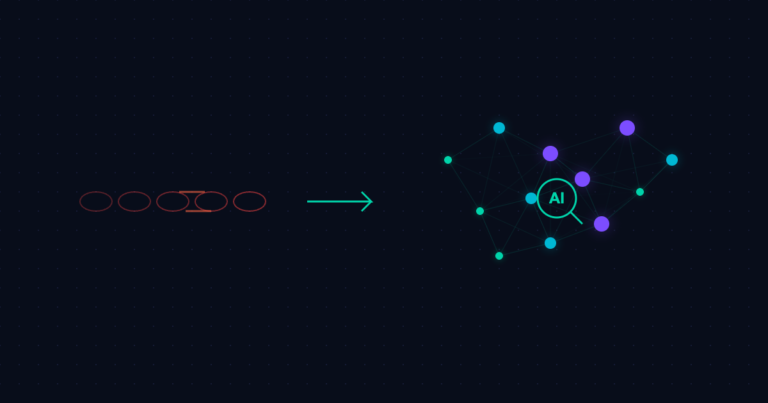
An AI teammate is an AI persona — with a name, a defined role, and a defined surface (web, phone, internal helpdesk) — that shares a single governed knowledge base with every other AI persona in the same business. The Brain is the architectural primitive that makes a teammate a teammate. Without it, you have an agent with a friendly name.
The category emerged for a specific reason. McKinsey’s 2026 State of AI report shows 78% of organisations now use AI in at least one business function, but fewer than one-third report meaningful financial returns — and the leading failure cause (cited by 52% of respondents) is data quality and fragmented knowledge. The teammate model solves the fragmentation problem at the architectural layer rather than the prompt layer: every persona reads from the same Brain, so they cannot drift apart by definition.
In practice: Simon answers web chat at midnight from the same Brain Maeve uses to answer the phone at 3 a.m., that Hugo uses to answer an internal HR question at 9 a.m. Update the Brain once — a new pricing tier, a public holiday schedule, a revised refund policy — and all three reflect the change simultaneously. There is no synchronisation layer because there is nothing to synchronise. NeoMind’s positioning captures this as “One Brain. Three Minds. One bill.“
What Is the Core Difference Between an AI Teammate and an AI Agent?
The core difference is whether knowledge is shared by design or by integration effort. An AI agent owns its own context; an AI teammate inherits context from a shared Brain. Everything else — the conversational style, the channel, the action surface — is downstream of that one choice.
The practical implications fall into four buckets. Knowledge consistency: agents drift as their prompts evolve; teammates stay aligned because there is only one source of truth — Forrester’s 2026 enterprise AI benchmark found organisations on a unified knowledge layer reach cutover 2.3× faster than those running parallel agent stacks. Operational cost: three agents mean three invoices, three integrations, three governance reviews; one teammate platform consolidates all three. Governance: under APRA CPS 230, three vendors mean three material service provider register entries; one teammate platform means one. Escalation: a teammate can hand off to another teammate using the same Brain — Simon escalates to Maeve, who calls back without re-asking the same questions.
A useful test: if your AI tool can answer “what’s our refund policy” on the web but cannot answer the same question on the phone without a separate integration project, you have an agent. If both surfaces answer identically because they share a Brain, you have a teammate.
Why Has the Vocabulary Become So Confusing in 2026?
Because every major vendor is now using “AI teammate” as a marketing term regardless of whether their architecture meets the definition. MYOB’s April 2026 partnership with Microsoft launched “AI teammates” embedded inside MYOB. Salesforce rebranded Einstein Copilot to Agentforce and now describes some agents as “digital teammates”. Atlassian Intelligence positions itself as a teammate inside Jira and Confluence. Canva launched “AI teammates” for design workflows.
This is a category-naming war, not a product-architecture war. Most of these “teammates” are embedded agents — they share context within their host product but not across the rest of the business. A MYOB AI teammate that knows your invoices does not, by default, share that context with your website chat or your phone line. The marketing language has converged faster than the architecture, which makes the term unreliable as a procurement signal. Deloitte’s 2026 State of AI in the Enterprise shows 31% of Australian organisations now have an executive-level AI owner — meaning the procurement conversation is happening at board level, where vocabulary precision matters most. Practical advice for an Australian buyer in 2026: ignore the badge, ask the architectural question — does this share a knowledge base across web, voice, and internal channels by design (not by integration), and can it be governed under a single APRA CPS 230 register entry?
Which One Does Your Business Actually Need?
If you have one channel, one workflow, and no plans to expand, an AI agent is the right tool. If you have customers reaching you through multiple channels and staff asking the same internal questions over and over, you need an AI teammate. The decision is volume × surface area, not company size.
Three signals that you need a teammate rather than an agent:
- Channel coverage. Customers reach you on at least two channels — typically web plus phone. Salesforce’s 2026 State of Service shows 76% of Australian customers expect a response within one business day and 41% of SMB calls already go to voicemail. One channel with an agent leaves the others uncovered; a teammate covers them with the same Brain.
- Internal load. Your operations team is answering the same HR, IT, payroll, and policy questions internally week after week. A Hugo-style internal teammate, sharing a Brain with your customer-facing personas, eliminates duplicated work and keeps internal and external answers aligned.
- Regulated data. Your business operates under the Privacy Act 1988, APRA CPS 230, the Voluntary AI Safety Standard, ACMA rules, or sector regulators like AHPRA or ASIC. Three agents from three vendors mean three vendor due-diligence packs and three incident runbooks. A teammate platform on Azure Australia East consolidates that into a single governable surface.
If none of the three apply, a well-built agent is the right answer and you should not over-buy. If two or more apply, the operational, governance, and consistency cost of stitching agents together will exceed the cost of a teammate platform within twelve months. BCG’s 2026 enterprise AI value benchmark consistently shows unified knowledge layers outperform stitched agent stacks on time-to-value, not on raw capability.
How Does NeoMind Define an AI Teammate?
NeoMind defines an AI teammate as an AI persona that (a) has a named role and a single channel, (b) shares one governed Brain with every other persona in the same business, and (c) is hosted onshore in Australia under a single contract. The three current teammates — Simon (web), Maeve (voice), Hugo (internal HR/IT) — all read from the same Brain and all run on Azure Australia East in the Sydney region. Update the Brain once and all three reflect it; sign one contract and all three are covered.
That choice is deliberate. The KPMG/University of Melbourne 2026 Trust in AI study found Australian trust in AI sits at 36% — second-lowest of 47 countries surveyed — meaning credibility of any AI deployment here depends on the customer believing it knows what it is talking about across every touchpoint. Inconsistent answers are not just an operational annoyance; they are a trust-destroying event in a market that starts from a low trust baseline. “One Brain. Three Minds. One bill.” is the architectural contract: one Brain because the alternative drifts, three Minds because customers and staff reach businesses through web, voice, and internal channels, one bill because three vendor contracts under APRA CPS 230 is three times the governance overhead.
What Should Australian Businesses Look For When Evaluating “AI Teammate” Vendors?
Ignore the marketing. Ask five architectural questions before signing any “AI teammate” contract in 2026, and accept no “in a future release” answers.
- Where is the knowledge stored? “Inside our product” means agent with friendly branding. “In a shared Brain accessible to every persona” means teammate.
- How many surfaces share that knowledge by default? Two or more surfaces sharing one Brain — without integration work — is the teammate threshold.
- Where is the data hosted? The only correct answer for Australian businesses is an onshore region (Azure Australia East / AWS Sydney / Google Cloud Sydney). Anything else triggers APP 8 cross-border disclosure obligations.
- How is the system governed under APRA CPS 230? The vendor should provide a single CPS 230 material service provider attestation, one risk classification, and one incident runbook.
- How are updates propagated, and what is the escalation path? Updating one Brain entry must reflect across all personas, and escalation between personas (web → phone, phone → internal) must preserve context. If either fails, the platform is not teamed.
The Bottom Line for Australian Businesses
An AI agent is a tool you buy to complete a task. An AI teammate is a persona you hire that shares a Brain with the rest of your AI workforce. Both have legitimate uses in 2026 — single-channel, low-volume, low-regulation businesses can get excellent results from a well-built agent, while multi-channel, internally-loaded, or regulated businesses will pay back a teammate platform within twelve months through reduced integration, governance, and consistency cost. The vocabulary war MYOB, Microsoft, Salesforce, Atlassian, and Canva opened in April 2026 has made “AI teammate” unreliable as a procurement signal — but the architectural test (shared knowledge across surfaces by design, hosted onshore, governable under one CPS 230 entry) remains reliable. Use the architecture, not the badge.
Neomeric is a Melbourne-based AI product and consulting company — and the team behind NeoMind, Australia’s onshore AI teammates platform. NeoMind ships Simon (web), Maeve (voice), and Hugo (internal HR/IT) as three personas sharing one Brain, hosted on Azure Australia East under a single contract.
Frequently Asked Questions
Is “AI teammate” just a marketing term for AI agent?
Sometimes yes, sometimes no. The architectural test is whether the system shares a single governed knowledge base across multiple AI surfaces by design, not by integration. If the answer is yes, it is a teammate platform regardless of vendor naming; if the answer is no, it is an agent with friendly branding.
What is the practical difference between Microsoft Copilot Agents and NeoMind teammates?
Microsoft Copilot Agents are task-specific agents embedded inside Microsoft 365 — they share context within Microsoft’s product surface but require integration work to share context with your phone system, your public website, or non-Microsoft tools. NeoMind teammates share a single Brain across web (Simon), voice (Maeve), and internal HR/IT (Hugo) by default, hosted onshore in Sydney.
Can you have AI agents and AI teammates in the same business?
Yes — and most Australian businesses in 2026 already do. Use agents for narrow, automatable workflows like invoice processing or lead routing where consistency across other channels does not matter. Use teammates for customer-facing and internal knowledge surfaces where consistency, trust, and APRA CPS 230 governance do matter.
Does the difference between agent and teammate matter for APRA CPS 230 compliance?
Yes. Under APRA CPS 230 (commencing 1 July 2026), every material service provider must be on a register with documented controls and an incident runbook. Three agents from three vendors mean three CPS 230 entries and three sets of vendor due diligence. A single teammate platform reduces that to one entry, which is materially less governance overhead for regulated entities.
Why do AI teammates need to be hosted in Australia?
For most Australian businesses processing customer data, hosting outside Australia triggers Australian Privacy Principle 8 cross-border disclosure obligations and may complicate APRA CPS 230 outsourcing controls. Azure Australia East (Sydney region) is the standard onshore option in 2026 and is what NeoMind teammates run on by default.
How do I know if my business needs an AI teammate or an AI agent?
Count your channels and check your regulatory exposure. One channel, low volume, no regulated data — an agent is enough. Two or more channels (web plus phone, plus internal helpdesk), or any regulated data under the Privacy Act, APRA CPS 230, or sector regulators — a teammate platform will pay back the difference within twelve months through reduced integration, governance, and consistency cost.
Ready to put a teammate on your business — not another agent? See how Simon, Maeve, and Hugo share one Brain at neomind.neomeric.com, or talk to the team at neomeric.com/contact about a 60-minute architecture review.